01 / Listening & service recovery
Hear the customer.
Act on the signal.
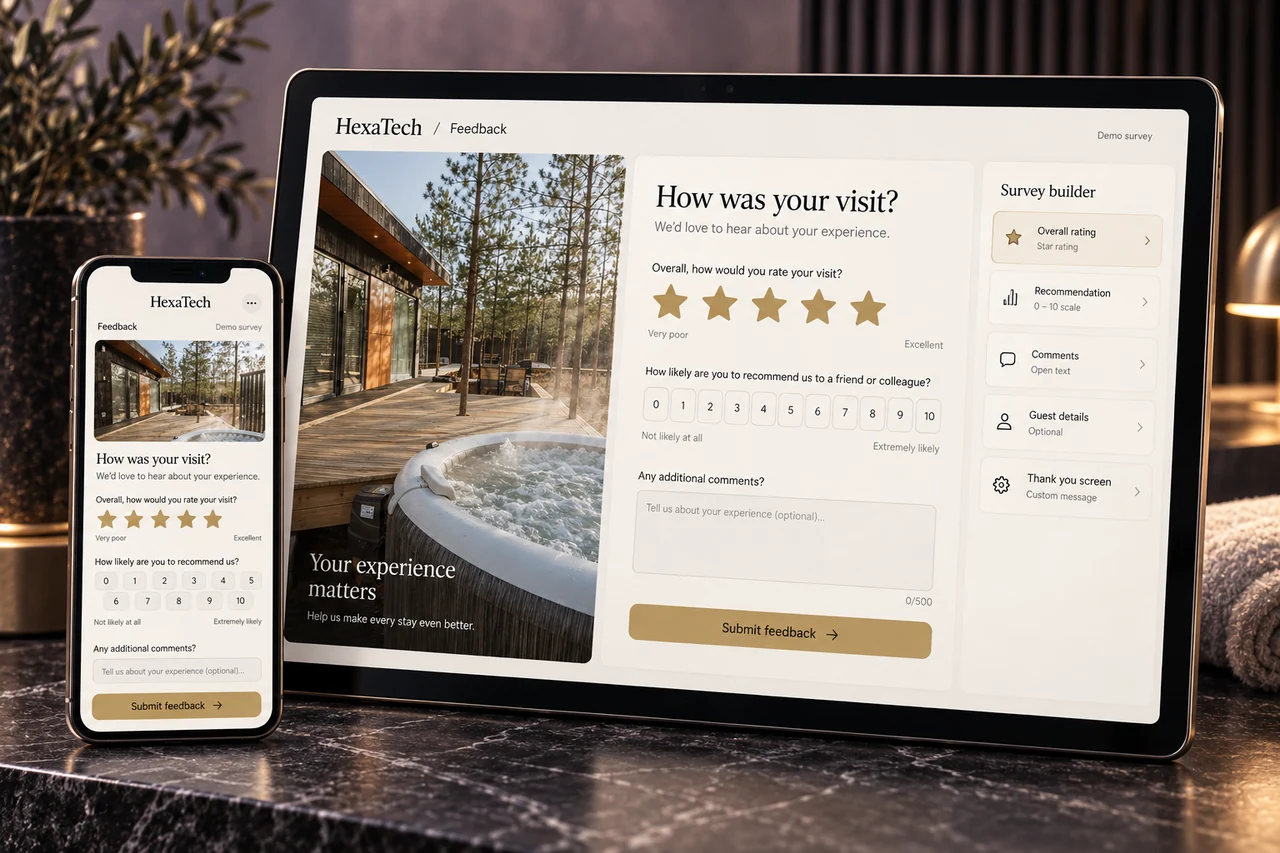
Survey creation, response collection and feedback review within the HexaTech customer platform.
Explore the project (opens in a new tab)The work & value02Potential at a glance
Released hours / month
Monthly capacity value
12-month value after costs
Capacity-value payback
03Challenge & solution
Every detail.
One business goal.
A score alone is not a service improvement. Teams need a way to ask useful questions, see the responses and decide who follows up.
Feedback becomes an owned service action and a clearer source for the next improvement.
- 01
Make feedback easy to give
Short questions, rating formats and optional comments keep the survey usable on a phone. The collection route can fit the service moment rather than require a long generic questionnaire.
- 02
Keep recovery visible
A low score can prompt useful context and a follow-up task. Ownership and a due action make the response something a team can deal with, rather than another dashboard notification.
- 03
Learn across responses
Themes and periods help the business review its service decisions. Private service recovery and public review activity remain different questions; the interface is not a reason to suppress inconvenient feedback.
- 04
Survey design
Use questions that support a decision.
04Business value
Modelled impact.
Released capacity
20.4hReleased hours / month
Feedback triage time
58.3% lessMinutes per task
Capacity value
£482Monthly model
The operating journey
42Follow-up actions
Capacity value / investment
106.4%12-month model
Time allocation
58.3%Released capacity
- Released time58.3%
- Remaining handling41.7%
Value after all modelled costs
£2,980Initial investment included
05The experience
From ask
to learn.
Feedback becomes an owned service action and a clearer source for the next improvement.
Survey design
Use questions that support a decision.
Service operations
Translate feedback into accountable follow-up.
Evidence review
Compare themes and periods without hiding low scores.


06The connected journey
From first intent
to useful action.
01Ask
Collect a concise service response.
02Understand
Keep the score and comment in context.
03Recover
Give the next action an owner.
04Learn
Review recurring service themes.
07Technology & expertise
Built to
keep improving.
Product UX
An experience shaped around the user.
Business context
Information the team can maintain.
Connected workflows
People, records and the next action.
Measurement
Useful signals with clear definitions.
Human oversight
Review, ownership and operational judgement.
Visual survey builder
Compose star ratings, scales, choices, text and other question types.
Conditional follow-ups
Ask the next question when it is relevant to the previous answer.
Branded experience
Style the introduction, questions and thank-you screen for the business.
Multiple collection routes
Share by link, QR, website widget, email invitation or reception kiosk.
Question-level analytics
Understand answer distributions and collection channels, with CSV export.
Service recovery
Bring responses that need attention to a person who can follow up.
08Let's do this
What could we
build for you?
Bring us the business challenge. We’ll connect the strategy, experience and working product around it.