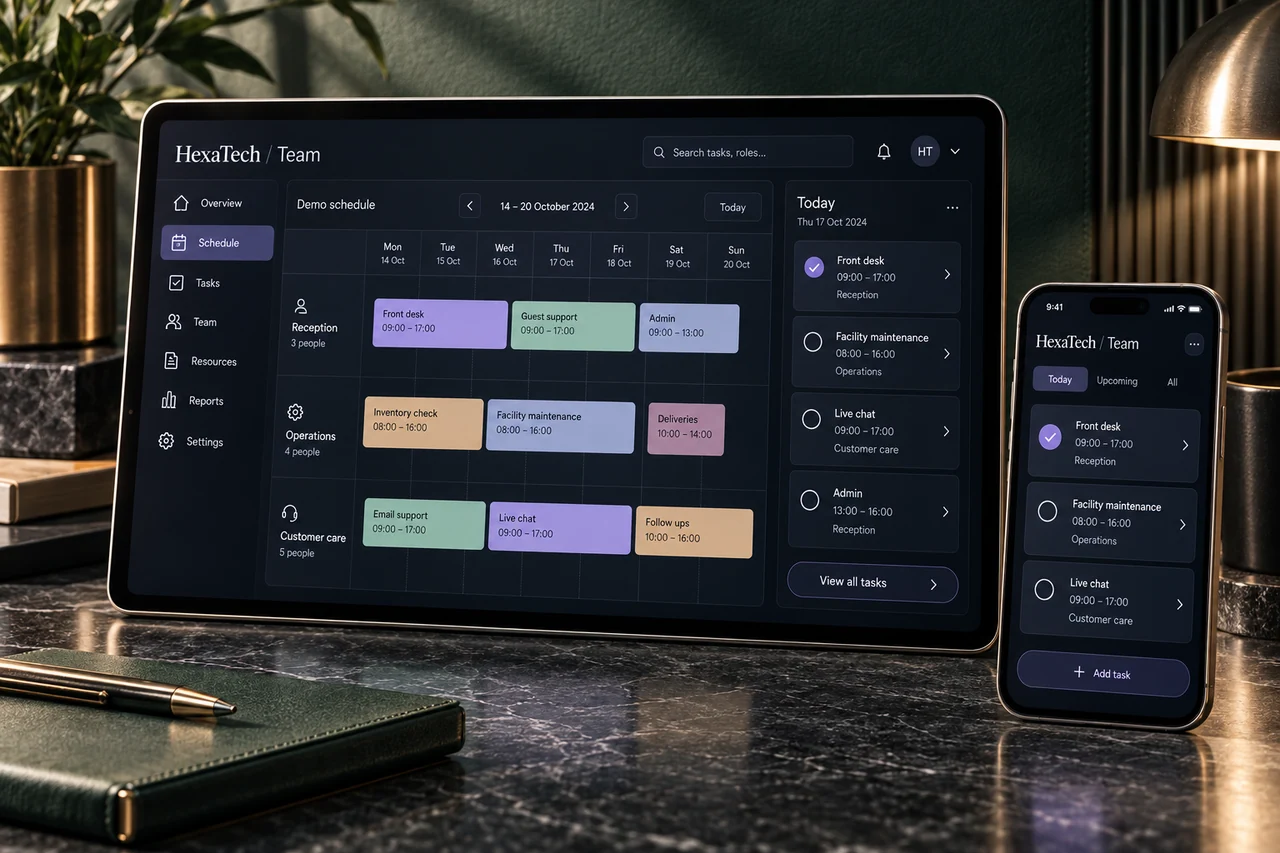
01 / People, tasks & time
People and time.
Better aligned.
A planning tool for staff activity, task ownership, working schedules and resources.
Explore the project (opens in a new tab)The work & value02Potential at a glance
Released hours / month
Monthly capacity value
12-month value after costs
Capacity-value payback
03Challenge & solution
Every detail.
One business goal.
A customer commitment becomes real work for a team. Tasks and appointments need to fit the available people, time and resources.
People, timing and ownership become visible in the same plan as the work to deliver.
- 01
An operating view of the day
Bookings and internal tasks can be reviewed across a shared schedule. Day, week and month views help the team see what must happen before focusing on an individual record.
- 02
Ownership beside the work
Roles and assignment make the task actionable. The experience distinguishes available work from work someone already owns, with context for the next handover.
- 03
Capacity as a planning question
Time and resource visibility help a manager review load and changes. The value is the ability to spot a conflict or unclear owner before it quietly becomes a service failure.
- 04
Operational UX
Show the useful overview before the individual task.
04Business value
Modelled impact.
Released capacity
20hReleased hours / month
Planning time per task
50% lessMinutes per task
Capacity value
£380Monthly model
The operating journey
252Completed tasks
Capacity value / investment
26.7%12-month model
Time allocation
50%Released capacity
- Released time50%
- Remaining handling50%
Value after all modelled costs
£960Initial investment included
05The experience
From plan
to rebalance.
People, timing and ownership become visible in the same plan as the work to deliver.
Operational UX
Show the useful overview before the individual task.
Resource modelling
Connect roles, timing and capacity.
Team coordination
Design for assignment, changes and handovers.


06The connected journey
From first intent
to useful action.
01Plan
Review demand and internal work.
02Match
Consider people, time and resources.
03Assign
Make responsibility explicit.
04Rebalance
Keep changes visible to the next owner.
07Technology & expertise
Built to
keep improving.
Product UX
An experience shaped around the user.
Business context
Information the team can maintain.
Connected workflows
People, records and the next action.
Measurement
Useful signals with clear definitions.
Human oversight
Review, ownership and operational judgement.
Industry task groups
Start with relevant groups and task templates, then adapt them to the team.
Day, week & month
Change perspective without losing the tasks in the plan.
Task ownership
Assign a person, time, duration and priority to the work.
Open task pool
Keep unassigned work visible so team members can claim it.
Team workload
Review work by person and adjust the distribution of tasks.
Time & completion reports
Compare planned and worked time and review completion patterns.
08Let's do this
What could we
build for you?
Bring us the business challenge. We’ll connect the strategy, experience and working product around it.